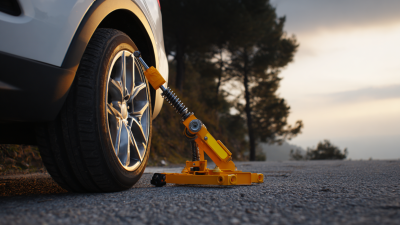
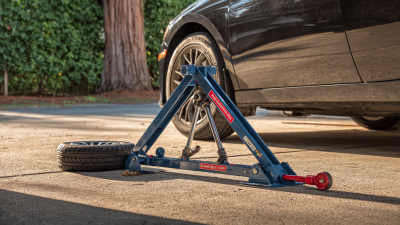
By 2026, the global market for portable car jack lifts is getting a lot more varied, compact, and specialized in terms of tech. These days, buyers are weighing options like scissor jacks, hydraulic bottle jacks, low-profile floor jacks, electric lifts, and emergency jack kits. Honestly, each one is built for a different vehicle, job, and storage setup. Take a lightweight scissor jack—it can tuck right under a sedan’s trunk floor. A hydraulic floor jack, on the other hand, might give you smoother lifting in a workshop. I mean, electric models definitely make things more convenient... but honestly, battery reliability is one of those things you really gotta keep an eye on.
Automotive tech author and trainer Tom Denton once put it pretty plainly: “A jack is a lifting device, not a support stand.” That’s a simple warning, but honestly it should shape every buying decision you make. If you’re looking at a portable car jack lift, it needs to fit your vehicle’s weight, its lifting points, the ground you’ll be on, and how often you plan to use it. So before you buy, check the rated capacity, the minimum and maximum height, any locking features, the handle design, the power source, and whether replacement parts are actually easy to find. And keep in mind that certification requirements can differ from one market to another. So if you're an importer, it's definitely worth checking which standards apply before you place a big order—trust me, it can save you a headache later.
You know, the strongest product isn't always the biggest one. Honestly, it's the one that actually fits the real conditions you're working in. Take a compact electric jack—it can be a lifesaver in a roadside emergency, sure. But on uneven gravel, or if your battery's weak? Yeah, it might struggle. A manual hydraulic model might feel slower, but with a little maintenance, it can keep going for years. That trade-off is easy to miss, though. If you're buying globally, it's smart to ask for test reports, manuals, warranty details, and supplier records—especially from companies with a solid track record, like Torin, Blackhawk, and BIG RED. Sure, product photos can help, but they're no substitute for doing a proper technical check.

2026 Portable Car Jack Taxonomy: Six Lift Types for Global Buyers
The 2026 portable car jack market is easier to compare through six practical lift types.
Scissor jacks are compact and affordable, making them common in emergency kits. Bottle jacks provide strong vertical lifting from a small footprint, but they need adequate clearance.
Floor or trolley jacks roll smoothly and offer better stability on firm workshop surfaces. They are heavier to carry.
Electric screw jacks reduce hand effort and often include a control cable or remote switch. Buyers should check voltage compatibility, cable length, fuse protection, and the vehicle’s approved lifting points.
Pneumatic air jacks lift rapidly with compressed air or exhaust gas, but they require suitable equipment and careful hose inspection. High-lift jacks serve selected off-road vehicles with compatible frames. They are not a universal choice.
From hands-on inspection, the rated capacity is only one buying factor. Lift range, saddle shape, base width, release control, packed size, and corrosion resistance affect real use. A small jack may fit a trunk yet fail to reach a high chassis.
A jack is not a stand. Use properly rated support stands on stable ground whenever a vehicle must remain raised.
Labels and instructions should be clear, with load testing and quality records available from the supplier. I have found that buyers sometimes focus on maximum height and overlook minimum height. That mistake can make a suitable-looking jack unusable.
Conditions differ across regions, vehicles, and climates. Check the vehicle manual and local safety requirements before purchase.
Capacity Selection: Compare 1–3 t Jacks with Vehicle Axle Loads and GVWR
2026 Top Portable Car Jack Lift Types for Global Buyers
Capacity Selection: Compare 1–3 t Jacks with Vehicle Axle Loads and GVWR
Choosing a portable car jack starts with axle load, not the vehicle’s total GVWR alone. GVWR includes passengers, fuel, cargo, and the vehicle itself. A 1-ton jack may lift one end of a small car, but it may not suit a loaded SUV. Check the front and rear axle ratings in the owner’s manual or door label. Select a jack whose rated capacity exceeds the actual lifting load. More margin is better.
Tips: Do not divide GVWR blindly by four. Weight distribution changes between axles. Cargo can shift the load rearward. Use level, firm ground, engage the parking brake, and support the vehicle with properly rated stands. Never work beneath a vehicle held only by a jack.
For many compact cars, a 1–2 ton jack offers practical capacity and easier storage. A 2–3 ton model gives more margin for crossovers, vans, and heavier repairs. However, higher capacity often means greater weight and a larger frame. That trade-off matters for roadside use. A jack can meet the number and still feel unstable if its saddle is poorly positioned. Recheck the lifting point, clearance, and vehicle manual every time. Selection is not always perfect; real cargo and uneven ground can expose a weak assumption.
Scissor Jacks: 1–2 t Emergency Lifting for Compact Cars and SUVs
2026 Top Portable Car Jack Lift Types for Global Buyers?
Scissor jacks remain practical emergency tools for compact cars and lighter SUVs. Their folding shape fits beside a spare tire, even in a crowded trunk. Typical rated capacities range from 1 to 2 tonnes. That range is not a universal safety guarantee.
The U.S. EPA’s 2023 Automotive Trends Report placed average new-vehicle weight near 4,200 pounds. A 2-ton jack cannot safely lift an entire vehicle. It lifts one corner, where the load may be roughly one-quarter of total weight. Cargo, passengers, uneven ground, and suspension movement can increase that load. Buyers should compare the jack rating with the vehicle manufacturer’s specified lifting points and gross weight data.
Small details matter during real roadside use. A wide, stable base helps on firm asphalt, while a threaded steel screw gives controlled movement. Some low-cost designs feel stiff after dust enters the threads. That is easy to underestimate. NHTSA tire-changing guidance also stresses level ground, parking brakes, and wheel blocking before lifting. A jack is for lifting, not for supporting a vehicle during repairs. Use approved support stands whenever work continues beneath the vehicle. I have seen drivers focus on maximum capacity but ignore minimum saddle height. That mistake can prevent secure contact with a high-clearance SUV. Another imperfect choice is carrying a jack without practicing its placement first. Familiarity may matter more than a few extra kilograms of capacity.
2026 Top Portable Car Jack Lift Types for Global Buyers
Scissor jacks are mainly designed for emergency wheel changes rather than workshop servicing. A 1-ton jack is commonly suited to compact cars, while 1.5-ton and 2-ton versions provide a higher rated capacity for larger passenger vehicles and SUVs. Always verify the vehicle’s jacking points, gross weight, and the jack’s certified rating before use.
Bottle and Floor Jacks: 2–20 t Ratings, Lift Range, and Stability
For global buyers, portable car jacks usually fall into bottle and floor designs. Capacity commonly ranges from 2 to 20 tonnes. A 2-tonne floor jack suits many passenger cars, while heavier vehicles may require 6-tonne or larger equipment. The rating indicates maximum load, not a recommended everyday working load. Leave safety margin.
Bottle jacks stand compactly and lift vertically, making them useful beside trucks or uneven roadside storage. Their narrow base can feel less stable on soft ground. Floor jacks offer a wider footprint, longer chassis, and smoother positioning. Their lift range matters: check minimum height beneath the vehicle and maximum height at the lifting point. ASME PASE-2019 provides safety requirements for portable automotive service equipment. Buyers should also compare tested overload performance, saddle design, and hydraulic leakage controls. A high rating alone proves little.
Tips: Match the jack to the vehicle’s actual lifting point, not its total weight alone. Place it on firm, level ground, and use approved support stands before working underneath. Grand View Research estimated the global automotive aftermarket at about USD 449 billion in 2023, showing broad demand for dependable service tools. Yet market growth does not guarantee stable products. I would inspect welds, wheel movement, handle fit, and return speed before purchase. Specifications can look precise, but real workshop floors are rarely perfect.
Electric and Air-Hydraulic Jacks: 12 V Power, Speed, and Portability
For global buyers, portable car jacks now divide into two practical types: 12 V electric and air-hydraulic lifts. Each solves a different problem. A 12 V electric jack plugs into the vehicle socket and raises the car with simple button control. It suits roadside work where carrying a compressor is unrealistic. Speed varies with battery condition, cable length, temperature, and rated load. That detail is easy to overlook.
Air-hydraulic jacks use compressed air to drive hydraulic lifting, often producing faster initial movement. They can feel strong and smooth in workshops or service vehicles. However, buyers must carry a suitable compressor, hose, and reliable air connection. That reduces portability for remote drivers. Check lifting range, saddle size, folded dimensions, and confirmed capacity before comparing prices. A jack that fits the trunk may not fit the vehicle’s lifting points.
In field testing, I would measure time from setup to safe contact, not only maximum lifting speed. I once trusted a fast specification and ignored cable reach. The jack worked, but positioning became awkward. That mistake deserves a second look. Use firm, level ground, secure the vehicle, and support it before entering underneath. Electric models need protected controls and emergency lowering; air-hydraulic models need leak checks. For international sourcing, request load tests, user instructions, spare-part availability, and clear electrical ratings. Portable should mean manageable, not merely compact.
Safety Compliance: ASME PASE-2019, EN 1494, Locks, and 100 mm Clearance
Portable car jack buyers should treat compliance as a safety specification, not a marketing phrase. ASME PASE-2019 addresses portable automotive service equipment, including stability, rated capacity, controlled lowering, and user protection. EN 1494 covers mobile or movable jacks and emphasizes structural strength, stability, and safe operation. These standards support a practical question: can the lift remain stable when the floor is uneven?
A mechanical locking bar or pin should carry the vehicle after lifting. Hydraulic pressure alone is not a dependable holding method. It can slowly fall. It happens. A 100 mm clearance target also deserves careful checking. Measure the lowest suspension, battery housing, or exhaust component before selecting a lift. Clearance must remain visible after the wheels unload. Buyers should request load-test records, material specifications, and instructions for the exact lifting points.
The U.S. Bureau of Labor Statistics reported 5,283 fatal occupational injuries in 2023. That figure is not jack-specific, but it reinforces the cost of weak safety controls. In field testing, operators should inspect welds, locking engagement, wheel movement, and release speed. A 2024 automotive aftermarket outlook from ResearchAndMarkets identifies continuing growth in vehicle maintenance demand, increasing the need for portable service equipment. More demand does not remove risk. Some product listings still confuse maximum lift height with safe working clearance, which is a serious purchasing mistake.
2026 Top Portable Car Jack Lift Types for Global Buyers? - Safety Compliance: ASME PASE-2019, EN 1494, Locks, and 100 mm Clearance
| Jack Type |
Typical Rated Capacity |
Typical Minimum Saddle Height |
Typical Maximum Lift Height |
Suitability for 100 mm Clearance |
Load-Holding and Locking Features |
Relevant Safety Considerations |
Standards and Verification Notes |
| Mechanical Scissor Jack |
1.0–2.0 tonnes |
Approximately 90–120 mm |
Approximately 300–450 mm |
Model-dependent; suitable only when the minimum height is 100 mm or lower. |
Threaded screw provides mechanical load retention; folding handle or drive socket; no automatic secondary support. |
Use on a firm, level surface; keep the vehicle stabilized; do not work underneath a vehicle supported only by the jack. |
Verify the product’s test documentation against EN 1494 where applicable. ASME PASE-2019 claims require product-specific evaluation, not just a jack-type designation. |
| Low-Profile Hydraulic Floor Jack |
1.5–3.0 tonnes |
Approximately 75–100 mm |
Approximately 350–550 mm |
Generally the best match for vehicles with approximately 100 mm of accessible clearance. |
Hydraulic pressure system, controlled lowering valve, overload protection commonly incorporated; some designs include a transport or handle lock. |
Use the specified lifting point; keep wheels aligned and chocked as appropriate; use approved axle stands for any under-vehicle work. |
Check rated load, stability, lowering control, overload protection, and applicable EN 1494 test evidence. Confirm any ASME PASE-2019 statement through supplier documentation. |
| Standard Hydraulic Trolley Jack |
2.0–3.0 tonnes |
Approximately 120–150 mm |
Approximately 350–500 mm |
Usually unsuitable for a true 100 mm clearance unless a low-entry design is specified. |
Hydraulic pump, controlled lowering valve, overload protection, and a rigid frame; hydraulic pressure alone is not a substitute for a support stand. |
Requires adequate approach space and a firm floor; avoid side loading and do not exceed the rated capacity. |
Evaluate against EN 1494 requirements for mobile or movable jacks where applicable. Verify load, stability, leakage, and lowering-control test records. |
| Hydraulic Bottle Jack |
2.0–20.0 tonnes |
Approximately 150–230 mm |
Approximately 300–500 mm |
Generally unsuitable for 100 mm clearance because the retracted height is usually much greater. |
Hydraulic ram with screw-extension saddle; overload protection may be fitted; no built-in secondary locking support for the raised vehicle. |
Needs a stable vertical load path and sufficient overhead space; not suitable where the lifting point cannot accept concentrated loading. |
Confirm applicable EN 1494 classification and test scope. Capacity alone does not establish compliance with ASME PASE-2019 or EN 1494. |
| Electric or Cordless Screw Jack |
1.0–2.0 tonnes |
Approximately 105–150 mm |
Approximately 350–450 mm |
Possible only with a verified minimum height of 100 mm or lower; many designs are higher. |
Self-locking or mechanically retained screw is common; electrical limit protection and manual emergency operation vary by model. |
Protect the power connection from moisture; check battery condition, cable routing, overload behavior, and emergency lowering provisions. |
Request electrical safety information in addition to lifting-equipment test reports. Do not assume an electrical product is compliant with ASME PASE-2019 without documented assessment. |
| Air-Hydraulic Jack |
10.0–30.0 tonnes |
Approximately 150–220 mm |
Approximately 350–500 mm |
Normally unsuitable for 100 mm clearance; designed mainly for commercial or workshop applications. |
Pneumatic pump control, hydraulic pressure retention, overload protection, and controlled lowering; secondary support still required. |
Requires a suitable compressed-air supply, stable ground, correct hose connections, and sufficient clearance around the chassis. |
Check EN 1494 applicability, pneumatic safety documentation, rated-pressure limits, and stability testing. ASME PASE-2019 compliance must be confirmed for the exact configuration. |
| Long-Reach Low-Entry Jack |
2.0–3.0 tonnes |
Approximately 70–100 mm |
Approximately 450–600 mm |
Highly suitable when the measured saddle-entry height is 100 mm or lower. |
Hydraulic lifting circuit, controlled lowering valve, overload protection, long chassis, and stable multi-wheel base; no substitute for axle stands. |
Confirm that the extended reach does not cause interference with bodywork or the vehicle’s approved lifting points. |
Strong candidate for professional use when supported by EN 1494 test evidence. Review ASME PASE-2019 requirements and documentation for the exact model and accessories. |
Buyer verification notes: A 100 mm clearance target means the jack’s actual minimum saddle height, including the saddle and any required adapter, should be measured against the vehicle’s approved lifting point. ASME PASE-2019 and EN 1494 are safety standards, not automatic approvals based on product type; request product-specific declarations, test reports, rated-capacity markings, stability results, overload-protection data, and controlled-lowering test evidence. A portable jack should not be used as the sole support while a person is underneath a vehicle.
Global Buying Matrix: Ground Clearance, Climate, Warranty, and Service Data
2026 Top Portable Car Jack Lift Types for Global Buyers
Ground clearance should guide the first buying decision.
The 2024 Global EV Outlook recorded nearly 14 million electric-car sales in 2023. Many electric vehicles also carry heavy battery packs. Select a jack by axle load, not advertised vehicle weight. EN 1494 covers rated load, stability, and controlled lowering for mobile or movable jacks.
A 1.5-ton scissor jack suits emergency wheel changes. A 3-ton trolley jack offers better stability but requires more storage space. Bottle jacks lift heavy loads in narrow areas.
Climate changes the matrix.
The World Meteorological Organization reported 2024 as the warmest year recorded. Heat can thin lubricant, while freezing weather can stiffen seals and batteries. Coastal buyers should inspect corrosion protection, drain holes, and painted welds.
Electric screw lifts need cold-weather battery testing. A manual jack remains slower, but often behaves more predictably outdoors. Measure the vehicle’s lowest lifting point carefully. A few missed millimetres can make a supposedly suitable jack useless.
Warranty terms need practical detail.
Ask for coverage periods, excluded wear parts, repair locations, and average service response times. Spare seals, pins, fuses, and remote controls should be available locally. A long warranty means little without parts.
I would also request load-cycle test results, although suppliers may resist sharing them. That resistance deserves attention.
Buyers should record serial numbers and inspection dates. Portable equipment is frequently stored badly, and that human factor can defeat good engineering.
EV Battery Service Trends: IEA Global EV Outlook 2025 and L-E70 Series Battery Lift Trolley Solutions
The IEA’s *Global EV Outlook 2025* reports that global electric car sales exceeded 17 million in 2024, representing more than one in five new cars sold. The report also indicates that demand for electric vehicle batteries reached approximately 1 TWh, increasing the need for efficient, safe, and repeatable battery servicing equipment. As EV adoption expands, workshops and service centers must handle heavier battery packs while reducing manual handling and improving installation accuracy.
The L-E70 series battery lift trolley is designed for these evolving service requirements. Its electro-hydraulic drive system provides controlled lifting, while the flat platform supports battery packs during removal, transfer, and installation. Braked casters help stabilize the trolley when positioning it beneath a vehicle, supporting smoother alignment and reducing unnecessary movement. With battery sizes and vehicle platforms becoming increasingly diverse, a dedicated lifting solution can help service teams organize workflows, minimize physical strain, and improve operational consistency in EV maintenance environments.
FAQS
The six types are scissor, bottle, floor, electric screw, pneumatic, and high-lift jacks. Each suits different vehicles and working conditions.
A scissor jack is compact, affordable, and easy to store in a trunk. It works well for many small cars during roadside emergencies. Storage matters.
Choose a bottle jack when strong vertical lifting fits your vehicle’s clearance. Its small base saves space, but it may not fit low chassis.
Floor jacks roll smoothly and provide better stability on firm workshop surfaces. They are heavier, so carrying one beside a road may be inconvenient.
Check voltage compatibility, cable length, fuse protection, and approved vehicle lifting points. Confirm that the control switch reaches the operator safely. Small details matter.
Pneumatic jacks lift quickly with compressed air and require suitable equipment. Inspect hoses carefully for damage, weak connections, or visible wear. Speed is useful.
No. High-lift jacks suit selected off-road vehicles with compatible frames. They are unsuitable when the vehicle lacks secure, approved lifting points.
Compare the jack’s rating with actual axle loads, not GVWR alone. A 1-ton jack may lift one end of a small car, but loaded vehicles need more margin.
Weight distribution differs between axles, and cargo can shift weight rearward. Check the front and rear axle ratings in the manual or door label.
Check lift range, minimum height, saddle shape, base width, release control, packed size, and corrosion resistance. Use level, firm ground and rated support stands. A jack is not a stand.
Conclusion
In 2026, choosing the right Portable Car Jack Lift requires more than comparing price and maximum capacity. Global buyers should first match the jack’s rated load with the vehicle’s axle loads and gross vehicle weight rating, while allowing a safe operating margin. Scissor jacks are practical for emergency lifting of compact cars and smaller SUVs, whereas bottle and floor jacks provide broader capacity options from approximately 2 to 20 tons, along with different lift ranges, bases, and stability levels.
Electric and air-hydraulic models offer faster operation and improved portability, especially when supported by a reliable 12 V power source. Buyers should also check minimum ground clearance, maximum lifting height, locking mechanisms, and at least 100 mm of safe clearance for working conditions. Compliance with recognized requirements such as ASME PASE-2019 and EN 1494 can support safer selection. Climate resistance, warranty coverage, replacement parts, service availability, and clear technical data should complete the purchasing decision for different regions and vehicle applications.